
Description
DRAYGOON
Concept Description & 3D Frame Design Brief
Project by Orfauna
Project Overview
Draygoon is not intended to be a traditional dragon sculpture.
He is designed to serve as the internal framework for a hand-finished mixed-media sculpture constructed primarily from copper wire, natural crystals, specialty lighting, and translucent wing materials.
The completed sculpture should appear elegant rather than monstrous, ancient rather than aggressive, and intelligent rather than fierce.
The 3D printed component is not the finished sculpture.
It is only the structural armature upon which the final artwork will be built.
Overall Appearance
Draygoon should appear:
Ancient
Noble
Watchful
Intelligent
Calm
Protective
Beautiful rather than intimidating
The overall posture should communicate awareness without aggression.
He is a guardian.
Not a predator.
Pose
Draygoon should be shown:
Standing on all four feet
Head elevated
Neck gracefully curved
Looking slightly downward as if observing someone nearby
Mouth closed
Wings partially open
Tail naturally curved for balance
The pose should suggest that he has either just landed or is quietly preparing to move.
He should never appear to be attacking.
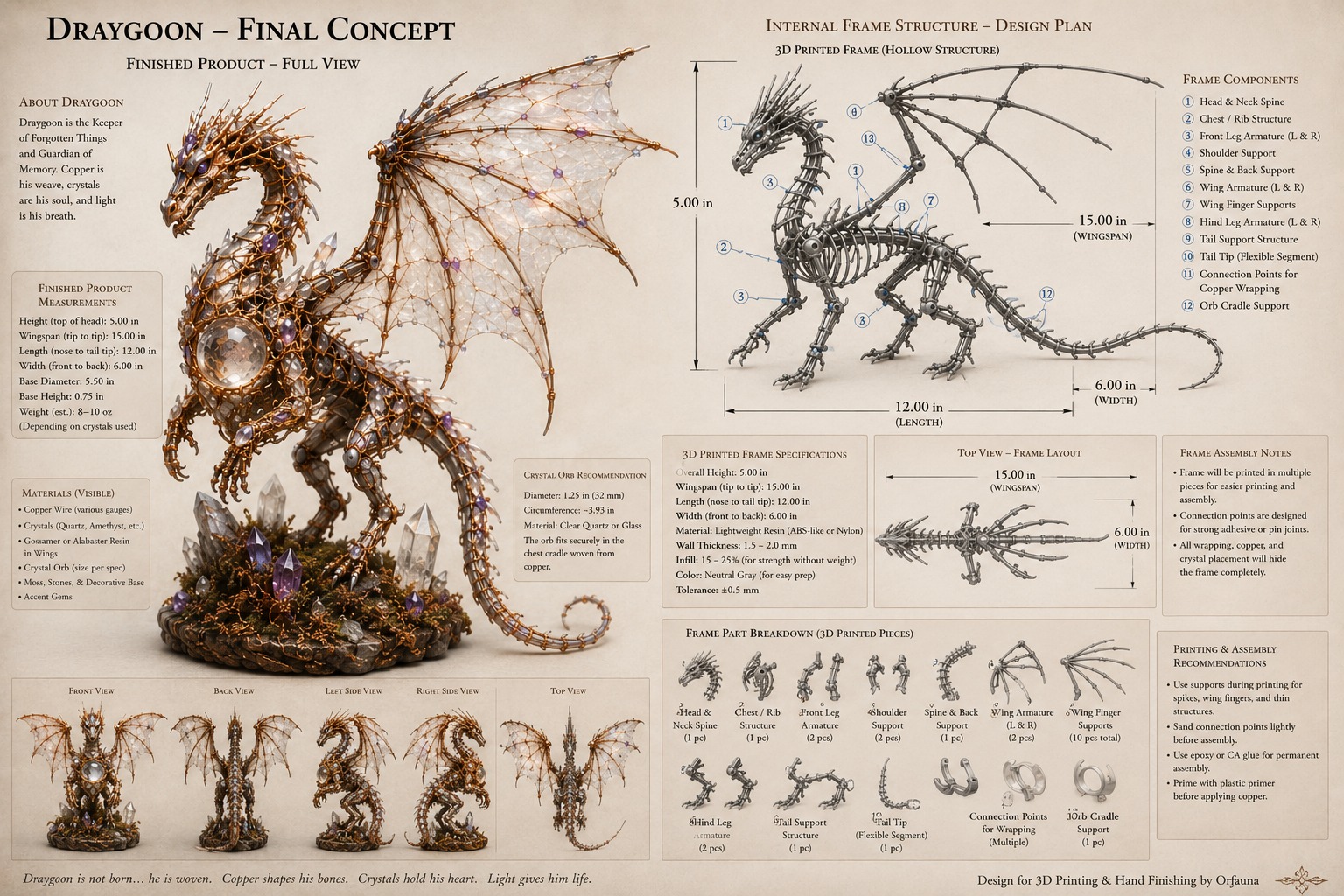
Overall Dimensions
Height (ground to highest point of head)
5.00 inches
Overall Length (nose to end of tail)
12.00 inches
Maximum Wingspan
15.00 inches
Body Width
Approximately 2.25 inches
Overall Depth
Approximately 6 inches
Construction Requirements
The model should be designed as an open armature rather than a solid sculpture.
Large solid surfaces are not desired.
Instead, the frame should resemble an anatomical skeleton with attachment points for copper wrapping.
The completed sculpture will conceal most of the printed framework.
Structural Requirements
The frame should include:
Neck spine
Rib cage
Pelvis
Leg armatures
Wing armatures
Tail armature
Head structure
Jaw support
Crystal attachment locations
Copper anchor locations
Wing Design
Each wing should consist of:
Primary support bones
Secondary support ribs
Open cells between ribs
Wing membranes will not be printed.
The open sections will later receive either:
• gossamer fabric
or
• translucent resin
or
• thin alabaster resin panels
The framework should securely support any of these materials.
Head
The head should communicate wisdom.
Eyes should be deep set.
Horns should sweep naturally backward.
No exaggerated spikes.
No roaring expression.
No open mouth.
Expression should appear thoughtful.
Tail
The tail should remain flexible in appearance.
It should taper gradually.
The final third should become increasingly delicate to accommodate copper wrapping.
Feet
Each foot should provide sufficient contact with the base for stability.
Individual claws should be defined but not oversized.
Surface
No scales are required.
Surface texture is unimportant because the printed material will later be concealed beneath copper wire.
The emphasis should be on structural strength.
Attachment Features
Small hidden holes or slots should be incorporated throughout the frame for:
Copper wire attachment
Crystal mounting
Lighting wires
Future electronics
Speaker concealment
Electronics Allowance
Future versions may include:
Bluetooth speaker
LED lighting
Rechargeable battery
Microcontroller
Internal wiring channels should therefore be considered during design whenever possible.
Estimated Weight
Printed frame only:
4–7 ounces
Finished sculpture:
Dependent upon copper, crystal selection, and electronics.
Artistic Intent
Draygoon is not built from copper.
He is woven from copper.
The printed frame exists only to support the artwork.
The finished sculpture should appear as though copper has grown naturally around an invisible living form.
Crystals are not decoration.
They represent memory.
Light is not illumination.
It represents life.
The viewer should never think,
"Someone made a dragon."
Instead, the goal is for them to quietly wonder,
"How did this dragon come into being?"
Category
3d printer
Comments
Similar Models