Description
Restoring Ability: Bionics Made Accessible in Mozambique
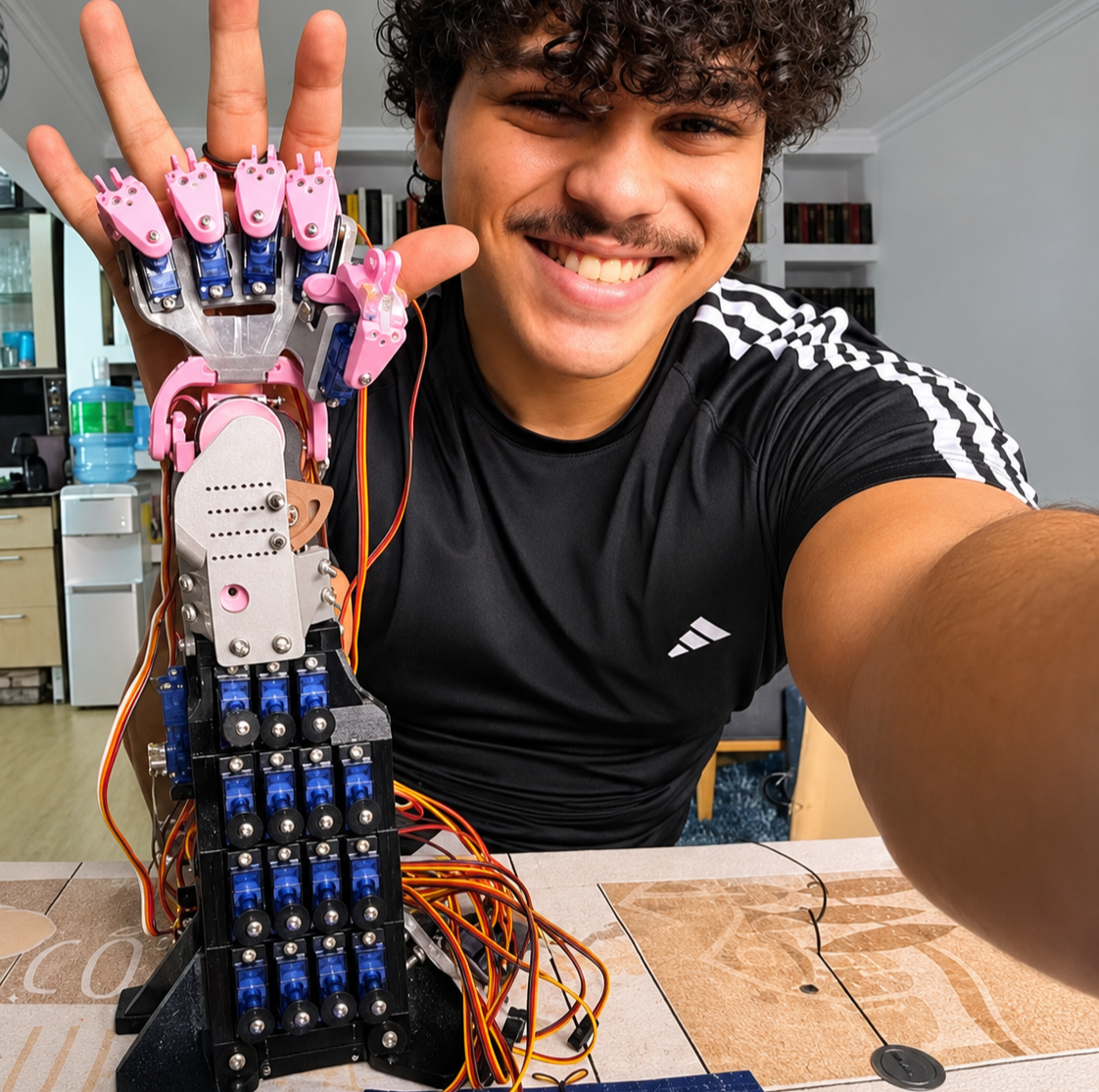
I am Miguel, an aspiring mechatronics engineer from Mozambique, developing an affordable, high-performance biomimetic prosthetic arm. My mission is to make advanced bionic technology accessible to underserved communities, beginning in Mozambique.
Building upon Will Cogley's Nilheim Mechatronics Bionic Hand Delta 1.1, my project has evolved into an independent engineering initiative focused on localizing prosthetic manufacturing.
I have redesigned CAD geometries to accommodate locally obtainable actuators, modified palm structures, motor mounts, bearings, and fasteners, and begun developing a biomimetic wrist. Every modification prioritizes mechanical performance, modularity, affordability, and the ability to manufacture and repair components using resources accessible in Mozambique and neighboring South Africa.
One of my most significant achievements has been independently assembling and successfully operating 22 servo actuators, controlled through two PCA9685 PWM drivers communicating over I²C with an Arduino Uno. This required electronic integration, power distribution, mechanical adaptation, debugging, and Arduino C++ programming.
My ongoing development includes positional feedback systems, structural optimization using FreeCAD, and research into future electromyographic (EMG) control, composite sockets, and more advanced mechanical assemblies.
3D printing is fundamental to this project. It enables the manufacture of customized finger mechanisms, palm structures, actuator mounts, and replacement components without expensive industrial tooling. However, affordable 3D printing services and equipment remain severely limited in Mozambique, making prototyping costly and dependent on external manufacturers.
My objective is to establish a practical workflow for designing, printing, testing, and improving prosthetic components locally, while documenting the process and sharing original engineering improvements where licensing permits.
This project is more than the development of a robotic arm. It is an effort to demonstrate that advanced, high-quality prosthetic technology can be affordable, locally manufacturable, and accessible to people regardless of their geographical or economic circumstances.
This model is licensed under
Creative Commons Attribution-NonCommercial-ShareAlike
High End Affordable Bionic Prosthesis Entered in Tools & Functional Prints

Print Profiles
+Show Print ProfilesDiscussed in
Similar models










Comments