About this video
What is Gyroid Infill?
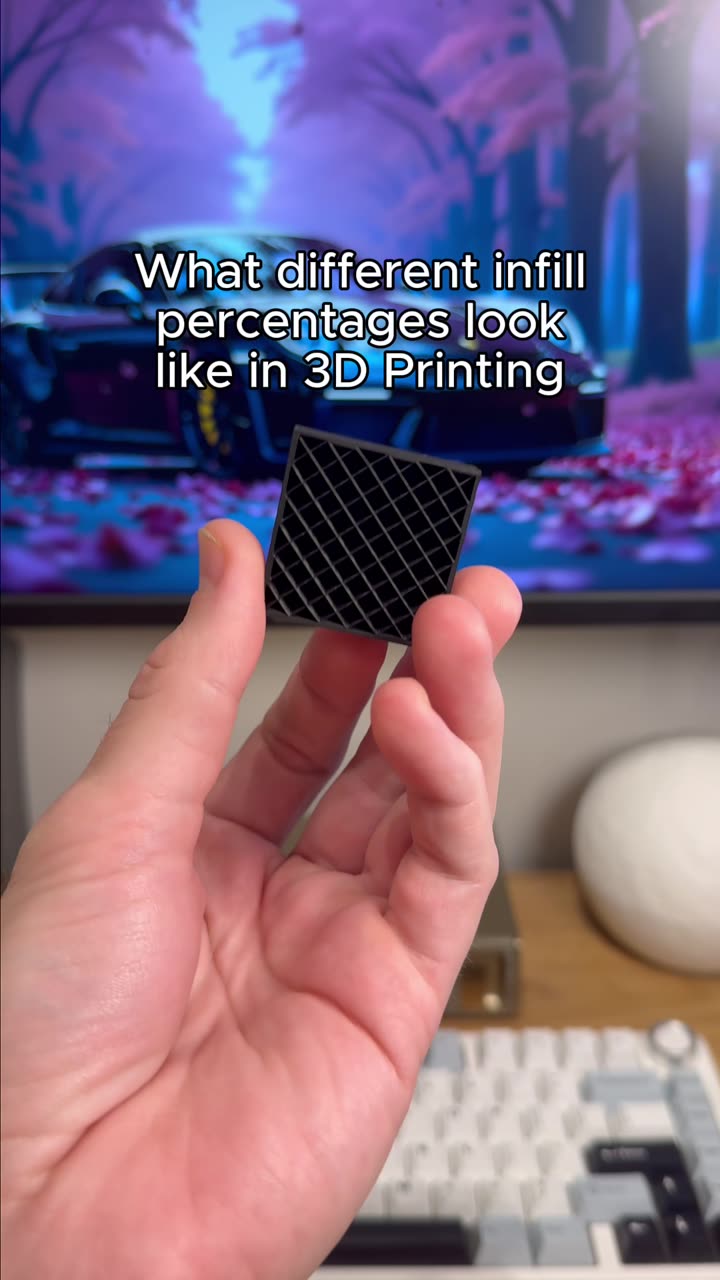
Gyroid infill is one of the most visually striking and structurally efficient infill patterns available in modern slicer software. Unlike traditional grid or line patterns, gyroid infill creates a continuous, wave-like lattice structure that provides excellent strength-to-weight ratios. This mathematical pattern, based on triply periodic minimal surfaces, distributes stress evenly throughout your print while using less material than conventional infill types.
Visual Comparison: 0% to 50%
When examining gyroid infill percentages side by side, the differences become immediately apparent:
- 0%: Completely hollow prints with only outer walls visible. Ideal for transparent projects or minimal-use items.
- 2%: Sparse, delicate lattice barely visible. Provides light structural support for top layers.
- 5%: Light but noticeable gyroid pattern. Good balance for decorative prints.
- 10%: Clear gyroid structure with visible wave patterns. Standard for most functional prints.
- 15%: Noticeably denser pattern with improved load-bearing capacity.
- 20%: Substantial internal structure. Recommended for functional parts that need durability.
- 25%: Heavy infill approaching mid-range density. Good for parts under moderate stress.
- 30%: Dense gyroid lattice providing significant strength. Suitable for functional prototypes.
- 50%: Half-filled prints with very dense internal structure. Maximum practical strength for most applications.
When to Use Each Percentage
Choosing the right gyroid infill percentage depends on your print's intended use:
- Low percentages (0-5%): Miniatures, figurines, vases, and decorative items where material savings matter more than strength
- Medium percentages (10-20%): General-purpose prints, enclosures, and parts requiring moderate durability
- High percentages (25-50%): Functional mechanical parts, brackets, load-bearing components, and prototypes
Strength vs. Weight Considerations
Gyroid infill excels at balancing these competing priorities. The pattern's continuous curves handle stress better than angular grid patterns, meaning you often achieve comparable strength at lower percentages. A print with 15% gyroid infill can match the rigidity of a 20% grid infill print while weighing less and using less filament.
Tips for Optimal Results
- Combine gyroid infill with higher wall counts for added strength without increasing infill percentage
- Use 15-20% gyroid infill as a reliable default for functional prints
- For vase-mode prints, 0% infill works perfectly with the spiral pattern
- Gyroid infill prints slightly slower than grid patterns but produces less warping
Frequently Asked Questions
Does gyroid infill print slower?
Gyroid infill can take 5-15% longer than simple grid patterns due to its complex toolpath, but the improved strength and reduced warping often justify the extra time.
Is gyroid infill better than cubic or grid?
For most applications, yes. Gyroid offers superior strength-to-weight ratios and better stress distribution compared to cubic or grid patterns.
What infill percentage should I use for miniatures?
0-5% gyroid infill works well for miniatures, saving material while providing enough support for top layers.
Can I use gyroid infill with 100% density?
While possible, anything above 50% infill begins to lose the visual and structural benefits of the gyroid pattern as it approaches solid fill.